
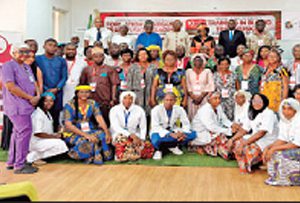
The National Blood Transfusion Service (NBTS), under the leadership of its General Manager, Professor Dora Mbanya, has launched a practical training programme aimed at strengthening the skills of blood bank professionals.
At the Regional Hospital of Garoua, laboratory benches, centrifuges and storage units have become more than routine medical equipment. For the next two weeks, they are the classroom for dozens of health professionals determined to strengthen one of the most vital links in Cameroon’s healthcare system, the blood transfusion chain.
The NBTS has officially launched the practical phase of a national training programme for its staff and personnel from 14 hospital blood banks. The ceremony was presided over by the General Manager of the NBTS, Professor Dora Mbanya. The training is part of the Operational Deployment Support Project for the National Blood Transfusion Service (PADOC), a strategic project designed to reinforce the technical, organizational and operational capacities of professionals involved in blood transfusion services nationwide. Supported by key technical and financial partners, notably Expertise France, the programme reflects Cameroon’s commitment to strengthening its health system and ensuring that every patient in need has access to safe blood products.
For many of the participants gathered in Garoua, the training is an opportunity to transform daily practice. Prior to the practical training, the 58 participants from the NBTS and 14 hospital blood banks had already completed an intensive online theoretical programme structured around nine modules covering the entire transfusion chain. From donor recruitment and laboratory testing to blood component preparation, distribution, haemovigilance and quality management, the modules were designed to harmonize knowledge and prepare participants for real-world application. The practical phase now places them directly in that real-world environment. Over the course of the training, participants will rotate through supervised sessions, demonstrations and practical exercises that simulate the everyday realities of transfusion services. They will analyse real cases, observe best practices and compare their routine procedures with national and international standards.
Safe Blood for Africa (SBFA), the implementing partner of the training, played a key role in identifying the training needs of the 14 participating blood banks. The organisation helped design an integrated learning approach that combines theory, hands-on practice and collaborative learning among professionals from different regions. Garoua was strategically selected as the training site for participants from the northern and eastern parts of the country. The Blood Bank of the Regional Hospital offers the technical environment required to host between 20 and 30 trainees for the two-week immersion programme.
A second session will follow in Yaoundé from April 6 to 18 at the University Teaching Hospital, where participants from the Centre and southern regions will undergo the same practical training.
Claudette CHIN