

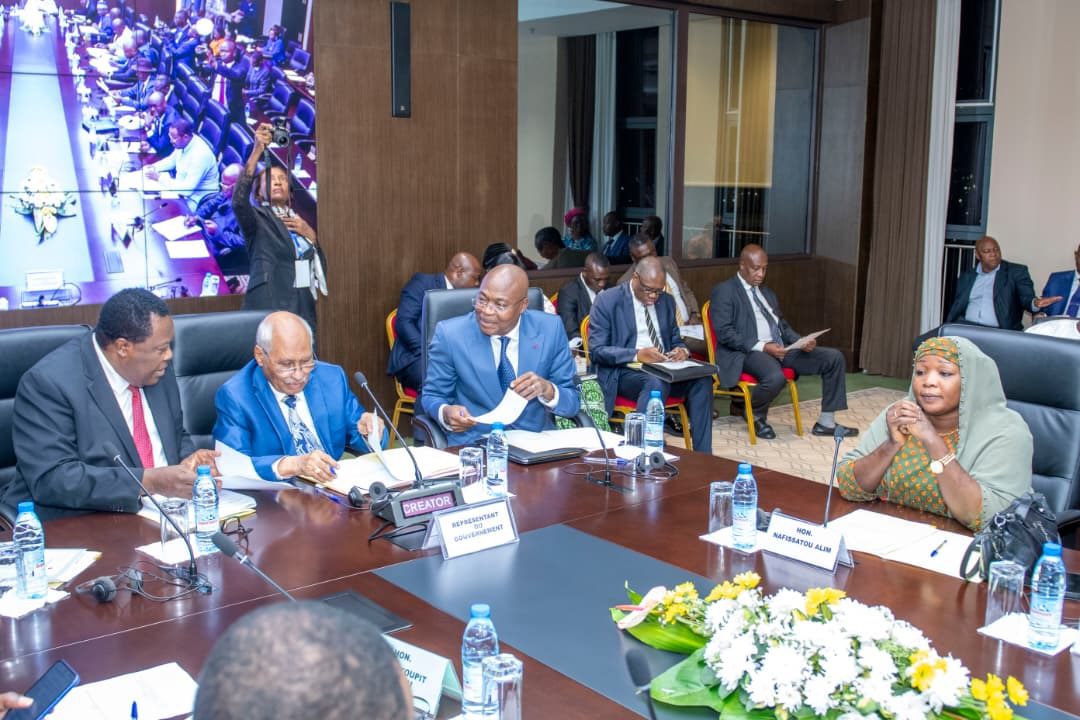
The legal architecture of one of the country’s key institutions – the Constitutional Council has been refined with MPs adopting amendments aimed at improving its organisation and functioning.
The reform adopted on 6 April 2026 updates Law No. 2004/4 of 21 April 2004, as previously revised in 2012, with a focus on enhancing clarity, coherence and institutional efficiency.
Presided over by House Speaker Théodore Datouo, the plenary session opened with the presentation of the committee’s report by Honourable Ngala Gérard. The proposed amendments seek to fine-tune procedural and organisational aspects of the Constitutional Council, ensuring that its mandate is exercised within a more precise and operationally effective legal framework.
Parliamentary scrutiny of the bill reflected both technical and policy concerns. While a preliminary objection raised by Honourable Ndam was rejected by an absolute majority, the general debate saw legislators interrogate the broader implications of the reform. Contributions from Honourables Evaristus Njong, Ngo Issi and Mbouangouere Rainatou emphasized the need for legislative precision, warning that ambiguities in legal texts could hinder institutional performance. They also used the platform to draw attention to pressing national concerns, notably youth unemployment, reminding Parliament of its duty to legislate with foresight and societal impact in mind.
Conversely, a number of lawmakers, including Honourable Manju Fru Nestus, Honourable Nkodo Dang, Honourable Ebangha Johanna and Honourable Essomba Bengono, rallied support for the bill. They argued that the amendments would strengthen the operational capacity of the Constitutional Council and contribute to the consolidation of the rule of law by making its procedures more streamlined and predictable.
Providing government’s response, the Minister of State, Minister of Justice and Keeper of the Seals, Laurent Esso, addressed concerns raised during deliberations. He clarified issues relating to professional advancement at the National School of Administration and Magistracy, indicating that appropriate mechanisms are already in place. On the functioning of the Constitutional Council, he underscored that the institution itself remains competent to provide further clarification on its internal processes where necessary.
In a related development, House Speaker Théodore Datouo granted an audience the same day to two prominent traditional rulers from the Adamawa Region. The Lamido of Ngaoundéré, HM. Mohamadou Hayatou Issa, and the Lamido of Tibati, HM. Mohamadou Hadi Barkindo, led a delegation that included the President of the Adamawa Regional Council, Aliou Issa, and Regional Traditional Adviser Issa Abba. The visit was an opportunity for the custodians of tradition to congratulate the Speaker on his election and to reaffirm their support for his mandate, as well as that of the President of the Republic, Paul Biya.
Reactions
Regina Mundi, Member Special Commission of Congress : “This is a historic moment for us”
The Head of State President Paul Biya has kept to his word that he was going to make reforms. The reinstitution of the post of the Vice President is a major reform and we are certain it is going to strengthen our democracy, making us feel at home in the way government functions. It might not be a one hundred percent perfect bill but it is a big beginning and knowing who our president is, he will continue to make things better for the citizens of this country.
Hon. Ebangha Johanna Agbor : “It’s for our people’s wellbeing”
As Members of Parliament, we had an obligation to work in tandem with the head of state to ensure that the Constitution is modified, having in mind the wellbeing of the population. President Paul Biya is one who loves stability and the present structure of the state with the coming into play of the post of Vice President will guaranty a smooth transition at the helm with any eventuality.
Grégoire Owona, SG adjoint du Comité central Rdpc : « Cette réforme va permettre une fluidification de notre administration »
Le chef de l’État a proposé une reforme fondamental. Certains députés ont apporté mille problèmes. Cette réforme va permettre de constater une meilleure fluidification de la démarche de notre administration et de notre État. Elle va rassurer, et nous en avons besoin, le monde économique et financier national et international. Ça c’est très important pour aujourd’hui et demain.
HRH. Nfon Mukete, Senator : “It is an important way forward”
From a business angle, in terms of stability and succession, one of the issues about Cameroon when you go into the international market, they always ponder over Cameroon’s succession plan. This had a negative effect on the market. Now that there is clarity in terms of succession in case the president cannot finish his mandate, there is certainty following the same policies and plans which have been put together by the head of state. It is good for the economy and the people of Cameroon.
Claudette Chin