

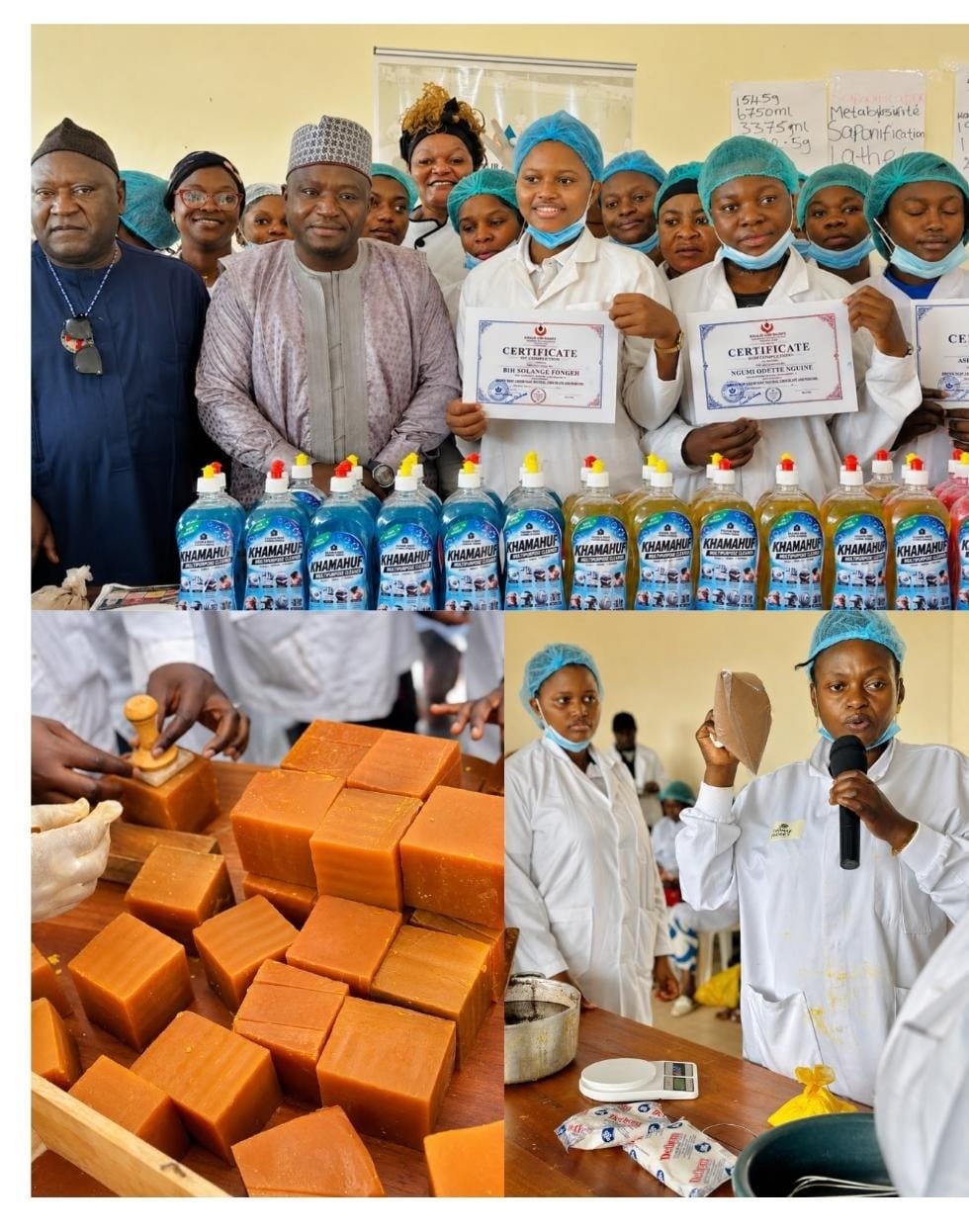
Some 113 participants have learned how to make laundry and liquid soap, chocolate and matinal, marking the beginning of a new economic chapter.
The free practical skills offered by the Khalir and Marife Humanitarian Foundation (KHAMAHUF) has given them a chance to turn knowledge into income and provide more securely for their families. The training brought together 113 participants from Bamenda and surrounding communities. Participants received practical instruction in the production of laundry soap, liquid soap, chocolate and matinal, with demonstrations designed to enable them to apply the skills personally or develop small businesses. Among those who attended was Kaah Margaret, head of the Oku community of internally displaced persons in Mbouda, who led a group of women to the training. For her, the value of the initiative goes beyond the skills acquired. “It means a lot to us. We came here with very little, but we are leaving with something that can change our lives. The skills we have learnt here, freely, can help us earn an income, put food on our tables and meet the needs of our families. For us, this is not just training. It is hope, dignity and a chance to rebuild our lives.”
She appreciated KHAMAHUF promoter Alhadji Khalir for giving women facing the hardship of displacement an opportunity to rebuild their livelihoods at a difficult time.
The initiative is the second such empowerment exercise organised by the foundation, following an earlier training in Yaounde. Its stated objective is to equip participants with practical, income-generating skills that can promote self-employment, entrepreneurship and improved livelihoods.
For these women, however, the real test begins after the training. A skill becomes meaningful when it can be turned into a product, a customer and ultimately an income. KHAMAHUF itself recognises the need for follow-up support, equipment, raw materials and additional entrepreneurial and marketing training to help participants move from learning to actual production.
In a setting where displacement has disrupted livelihoods, such an opportunity offers not only a lesson in production but a pathway towards self-reliance.
Claudette Chin