

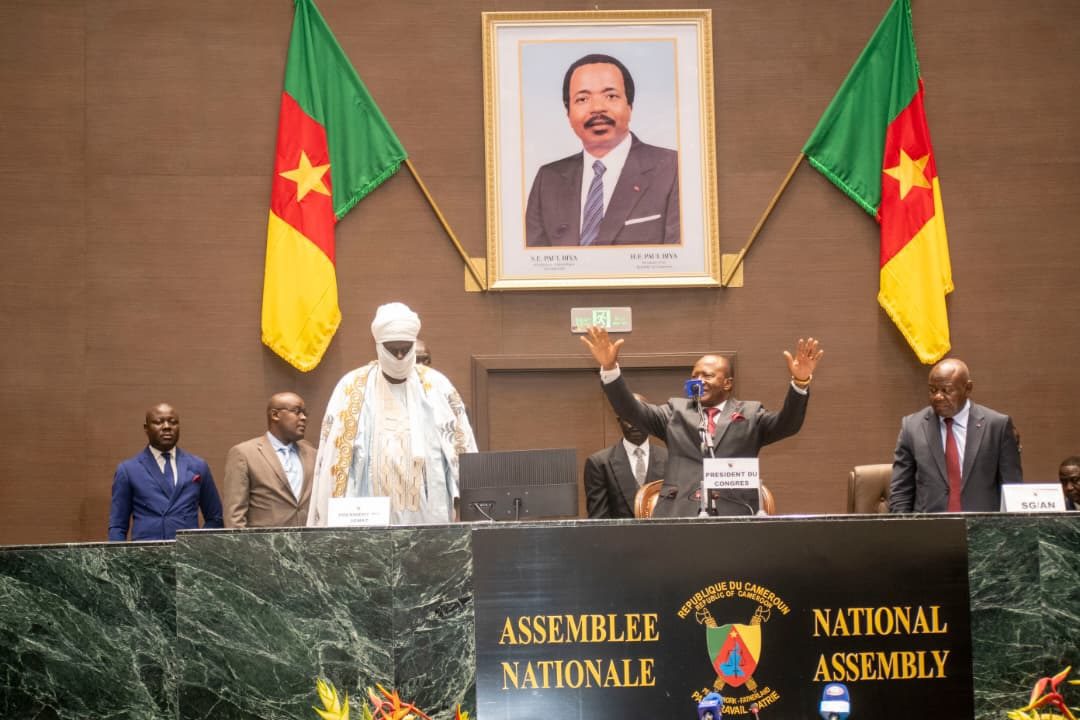
The reform was adopted from April 2 to 4, 2026, during the sixth Congress of Parliament held in Yaounde and chaired by the Speaker of the National Assembly, the Rt. Hon. Théodore Datouo.
At a time when stability remains a key value for national progress, Cameroon has chosen clarity, continuity, and responsibility. The sitting, was the first of its kind to revise the Constitution since the Senate became operational in 2013. Hon. Datouo was assisted at the opening plenary by the President of the Senate, Aboubakary Abdoulaye, and the Clerk of the National Assembly, Essian André Noël.
Right from the start, the message was clear. The reform follows the direction set by the Head of State during his swearing-in on November 6, 2025, where he called for improvements in the management of public affairs. Addressing members of Congress, the Hon. Datouo recalled that the initiative to amend the Constitution is the sole prerogative of the President of the Republic, exercised in line with the law.
To examine the bill in detail, a Special Commission of 30 members was set up, bringing together 15 Deputies and 15 Senators. The balance between the two chambers ensured that the work was carried out with fairness and discipline. The Commission met at the Paul Biya Glass House and quickly organised its bureau under the leadership of Honourable Etong Hilarion, with Senator Etame Massoma David as Vice President. The bill was presented and defended by the Minister of State, Minister of Justice and Keeper of the Seals, Laurent Esso. After careful review, the Commission adopted its report on April 3, clearing the way for the vote in plenary.
In the end, Parliament gave its approval to the creation of the Vice President post. The new provision introduces a clear line of succession at the head of the State. In the event of vacancy, the Vice President, appointed by the President of the Republic, will take over and ensure continuity in governance. Many members of Parliament welcomed the reform during discussions. Hon. Nkodo Dang noted that it will support the proper functioning of institutions, while Hon. Ebangha Agbor described it as an important adjustment that responds to present realities and strengthens coordination at the top of the State.
Beyond the constitutional amendment, Parliament also examined changes to the law governing the Constitutional Council. These adjustments now take into account the role of the Vice President, especially in situations of resignation or incapacity of the President of the Republic. This brings greater clarity to institutional procedures.
The Congress unfolded in a calm and orderly atmosphere, showing the ability of Cameroon’s institutions to address important issues with responsibility. The participation of both chambers, working side by side, highlighted the strength of the country’s bicameral system.
With this reform, Cameroon has chosen to organise continuity at the highest level and avoid uncertainty in moments that require clear direction. The decision taken by Parliament follows the vision set by the Head of State and reinforces the structure of governance.
Claudette Chin