

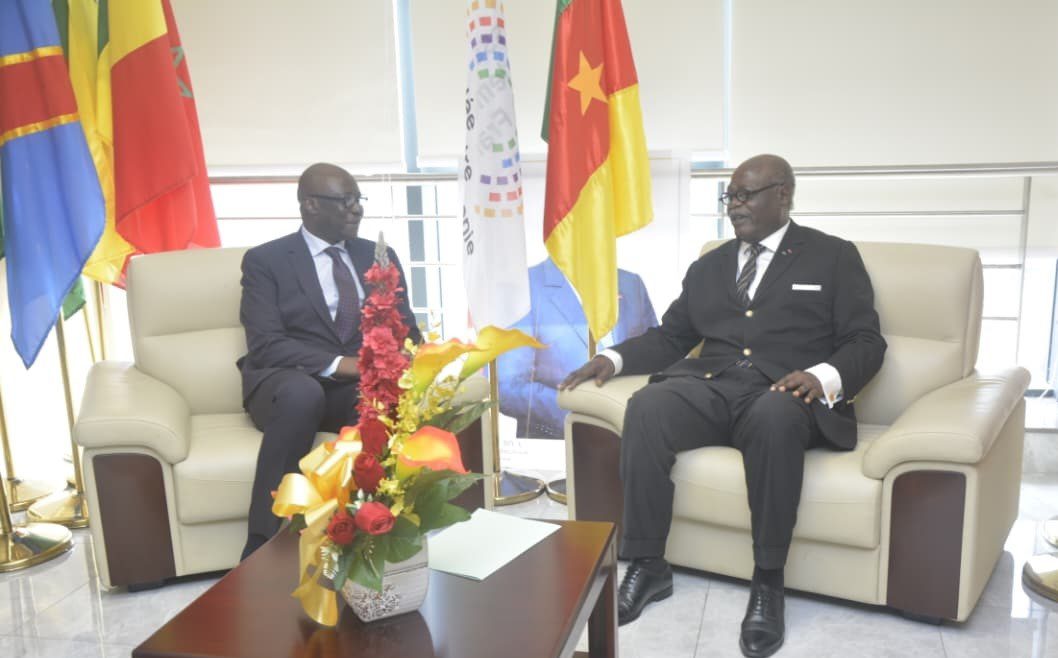
As preparations intensify for the 51st General Assembly of the Parliamentary Assembly of La Francophonie, the Hon. Hilarion Etong, has granted a high-level audience to APF envoys in Yaoundé.
In the bid to reinforce coordination efforts ahead of the major parliamentary gathering the President of the Cameroon branch, Hon. Hilarion Etong, granted an audience to key representatives of the APF General Secretariat during their working visit to the country.
The meeting brought together Bachir Dieye, Main Adviser for Africa, and Sékou Kanté, Adviser for the Africa Region – two significant figures. Their mission was to assess, verify, and, where necessary, recalibrate Cameroon’s readiness ahead of the July 7–12, 2026 assembly in Yaoundé.
Far from a ceremonial exchange, the audience served as a strategic checkpoint. Discussions focused on the state of preparations, coordination mechanisms, and adherence to timelines, areas where international events are often won or lost. Cameroon’s ability to deliver a seamless assembly is now tied not just to planning, but to disciplined execution across multiple structures.
This engagement was complemented by a broader evaluation session held at the Paul Biya Glass House, where the 17 subcommittees tasked with organizing the event presented their progress reports and operational roadmaps. Chaired by Hon. Lydienne Epoube on behalf of the APF President, the meeting provided a platform to align internal efforts with external expectations.
APF delegates commended the work accomplished since the installation of the subcommittees in January, while also emphasizing the critical importance of respecting deadlines, a subtle but clear reminder that readiness is measured in outcomes, not intentions.
Beyond logistics, the stakes are broader. The upcoming assembly is expected to gather over 400 delegates from across the Francophonie, preceded by the Youth Francophonie Parliament on July 6, which will bring together nearly 100 young representatives. These parallel engagements position Cameroon not only as host, but as a focal point for intergenerational dialogue within the Francophone parliamentary space.
A guided tour of key facilities further confirmed that infrastructure, accommodation, and logistics meet APF standards. Yet, as the audience itself highlighted, meeting standards is only the baseline. The real challenge lies in delivering an event that strengthens Cameroon’s standing within the Francophonie and leaves a lasting institutional imprint.
Claudette Chin

